In this guide · 11 practical sections
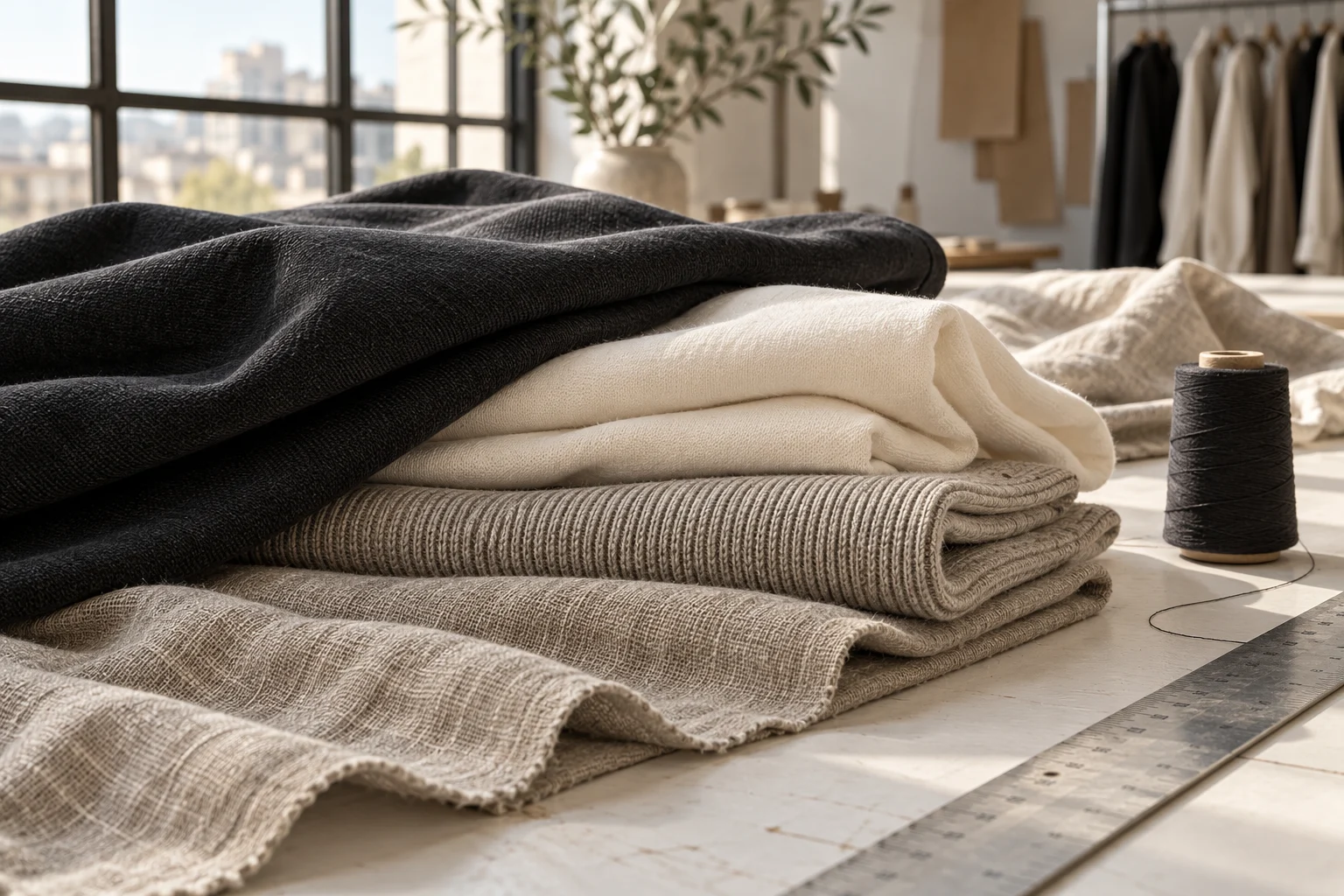
Jersey and interlock
Single jersey is commonly used for T-shirts and lightweight tops. Cotton jersey targets can range from about 170 to 300 gsm, depending on the intended handle and fit. Interlock has a different knitted structure and a smoother, more substantial feel. Always assess a physical swatch for opacity, recovery and drape instead of choosing from weight alone.
French terry and fleece
French terry has loops on the reverse; brushed fleece has a raised, warmer inside surface. Sweatshirt projects often explore approximately 240–420 gsm terry or heavier fleece constructions. Fibre mix, brushing and finishing affect warmth, pilling and dimensional behaviour. Specify whether the reverse is looped or brushed and test the finished fabric.
Linen, cotton and woven blends
Linen offers a characteristic texture and often a crisp, airy handle, while cotton blends can change softness, creasing and price. Woven linen projects may explore around 125–180 gsm depending on opacity and drape requirements. Check seam performance, shrinkage and dye-lot appearance. A linen look does not establish the actual fibre composition.
Stretch and performance materials
Elastane blends can offer stretch, but recovery, opacity and moisture behaviour depend on the full material construction. Leggings need to be checked under stretch, not only laid flat. Confirm stretch direction, percentage and recovery, and review seam elasticity. A performance claim should be supported by a relevant test rather than the fibre name alone.
Source with a complete specification
State composition, construction, gsm, usable width, colour, finish and required documentation. Stock availability changes. Custom knitting or dyeing may require around 200 kg per colour; custom woven orders may require around 1,000 metres per colour. These are planning guidelines to confirm with the supplier, not a promise of availability. When contacting Tuğhan Textile, identify your physical material reference and clearly mark any fabric decisions that are still pending.
Combed cotton, open-end and the meaning of “first quality”
Ask what a seller means by “first quality”: fibre selection, spinning method, yarn count, fabric construction, defect level or finished performance. Combed and open-end describe different processing choices; neither word alone is a complete garment specification. Compare physical swatches and agree pilling, shrinkage, colourfastness, surface appearance and hand-feel requirements. A higher GSM alone does not demonstrate higher quality.
Planning a 350–360 GSM fleece in several colours
Specify the fibre composition, knit structure, brushed or unbrushed back, usable width, finished GSM tolerance and expected washed feel. Then separate ready-stock options from a custom-dyed programme. Each custom colour may have its own mill minimum and lead time. Seven colours split across a small garment order can fail those minimums even when the collection total looks large. Ask for the current material-specific minimum rather than applying the standard garment MOQ to custom fabric.
Organic, branded fibre and certified: request the right evidence
A fibre name, organic description or certification logo is not a complete evidence trail. Ask for the actual material composition, supplier, relevant certificate scope and validity, and any transaction documentation required for your claim. Confirm whether the chosen stock quality is available with the requested evidence; an alternative may require custom production. Do not add a certification logo to a label simply because a similar fabric was certified.
Cotton-linen blends and other natural-fibre requests
Translate the preferred fibre into a product requirement: surface character, drape, weight, opacity, crease acceptance, care method and target price. Compare the actual blend and construction in a physical swatch. “Natural” is not a measurable softness or durability specification. If you request merino, add fibre fineness information where available; if you request a branded fibre, clarify the evidence needed to make that claim.
A useful sourcing checklist
| Specification | Record before quoting |
|---|---|
| Composition | Actual fibre percentages, including elastane |
| Construction | Single jersey, interlock, terry, twill or other agreed structure |
| Weight & width | GSM and usable width, with tolerances |
| Colour & finish | Physical reference, dye method and agreed hand feel |
| Performance | Shrinkage, recovery, opacity and care test requirements |
32 fabric starting points. Compare before you choose.
Illustrative development ranges, not a stock catalogue or a fixed quality grade. Fibre blend and finishing must be specified separately. Search by material, garment or a risk you want to check.
| Material / construction | Family | Starting range (gsm) | Typical use | Handle / character | Checks before approval |
|---|---|---|---|---|---|
| Combed cotton single jersey | Knit | 170–220 | Everyday T-shirts, tops | Soft surface and light drape | Opacity; shrinkage; spirality; neck recovery |
| Heavyweight cotton jersey | Knit | 240–300 | Structured tees, streetwear | Substantial, compact handle | Seam bulk; neck balance; drape after wash |
| Cotton interlock | Knit | 200–260 | Smooth tops, lounge sets | Smooth face and reverse | Dimensional change; recovery; seam thickness |
| Cotton pique | Knit | 180–220 | Polo shirts | Textured surface | Collar stability; placket distortion; shrinkage |
| Light French terry | Knit | 240–300 | Sweatshirts, lighter joggers | Looped reverse | Loop snagging; recovery; width stability |
| Heavy French terry | Knit | 320–420 | Premium sweats, joggers | Dense looped reverse | Bulk at joins; elastic recovery; drying time |
| Cotton-rich brushed fleece | Knit | 320–350 | Hoodies, sweatpants | Soft raised reverse | Pilling; shade; lint; shrinkage |
| Extra-heavy brushed fleece | Knit | 450–600 | Heavy streetwear | Weighty, warm handle | Machine handling; hood balance; packed weight |
| Cotton-elastane rib | Knit | 180–350 | Neckbands, cuffs, fitted panels | Crosswise stretch | Recovery and matching main-fabric shrinkage |
| Linen jersey | Knit | 160–180 | Summer tees, light tops | Fluid linen texture | Growth; transparency; seam stability |
| Cotton-modal jersey | Knit | 170–240 | Soft tops, lounge garments | Soft, flowing drape | Surface fuzz; recovery; finishing response |
| Viscose jersey | Knit | 160–240 | Draped tops, dresses | Fluid, soft feel | Wet handling; growth; opacity |
| Lyocell jersey | Knit | 160–240 | Soft essentials | Smooth, fluid handle | Surface change; seam stability; care validation |
| Nylon-elastane knit | Knit | 180–300 | Leggings, bras, activewear | Stretch and recovery vary | Stretch opacity; recovery; seam elongation |
| Polyester mesh | Knit | 80–150 | Ventilation panels, linings | Open construction | Snagging; seam support; opacity |
| Merino-blend jersey | Knit | 160–220 | Base layers, fine tops | Fine wool handle | Care sensitivity; pilling; dimensional stability |
| Hemp jersey | Knit | 160–240 | Textured casual tops | Dry, natural texture | Yarn variation; softening; shrinkage |
| Cotton-hemp jersey | Knit | 170–250 | Natural-fibre tees | Texture with blended softness | Shade; handle; wash appearance |
| Linen plain weave | Woven | 125–180 | Shirts, dresses, summer sets | Crisp, textured drape | Opacity; seam slippage; shrinkage |
| Cotton-linen blend | Woven | 130–220 | Shirts, shorts, coordinated sets | Blend-dependent structure | Composition; creasing; usable width |
| Cotton poplin | Woven | 110–150 | Shirts, blouses | Crisp, smooth surface | Opacity; seam puckering; pressing |
| Cotton twill | Woven | 240–320 | Trousers, overshirts | Diagonal weave, structured | Seam bulk; shrinkage; abrasion |
| Cotton canvas | Woven | 220–380 | Workwear, bags, overshirts | Firm, durable-feeling handle | Needle penetration; seam bulk; fraying |
| Light woven viscose | Woven | 100–160 | Fluid dresses, blouses | Soft, flowing drape | Seam slippage; distortion; wash change |
| Satin construction | Woven | 120–220 | Blouses, occasion pieces | Lustrous surface | Snagging; seam slippage; fibre composition |
| Georgette construction | Woven | 70–120 | Light dresses, overlays | Sheer, textured drape | Lining needs; seam finish; transparency |
| Taslon-type nylon | Woven | 110–170 | Light outerwear | Textured synthetic handle | Coating; seam behaviour; water claim testing |
| Recycled polyester shell | Woven | 110–180 | Light jackets, shells | Finish-dependent handle | Traceability; DWR performance; seam design |
| Softshell composite | Composite | 220–380 | Outdoor jackets, vests | Layered, structured stretch | Bond stability; seam bulk; tested performance |
| Sherpa / teddy pile | Pile | 250–500 | Warm outer layers, linings | Raised pile | Pile direction; shedding; seam bulk |
| Velvet / velour | Pile | 220–400 | Lounge and statement pieces | Directional pile surface | Nap direction; crushing; shade orientation |
| Faux suede | Composite | 200–380 | Jackets, overshirts | Suede-like surface | Needle marks; shade direction; care response |
Further technical reading: CottonWorks quality testing ↗ · Dimensional change and skew ↗. Tables are original planning guidance, not specifications or test certificates.
Material maths: switch between metres and kilograms.
kg = width in metres × length × gsm ÷ 1,000. This calculates fabric mass, not garment cutting efficiency.
Questions, answered
Is gsm the same as garment weight?
No. GSM is grams per square metre of fabric. Finished garment weight is the total mass of the assembled product, which may also include trims and decoration.
Can you guarantee a certified fabric from a colour photo?
No. Request the specific material, current documentation and traceability required for your order. A visual reference does not establish certification.
Can I convert a price per metre into a price per kilogram?
Yes, if you know usable width and gsm. One linear metre weighs width in metres × gsm ÷ 1,000 kg. Divide price per metre by that mass. Use the material math tool.
Does elastane percentage tell me how far the fabric stretches?
No. Knit construction, yarn and finishing also matter. Request measured stretch and recovery under a defined method.
What is the difference between fabric width and usable width?
Usable width excludes portions that should not be cut, such as unusable edges. Consumption calculations should use the agreed usable width.
Can I combine rib and body from different suppliers?
It can work, but shade, recovery and shrinkage need to be evaluated together. Matching appearance before care is not sufficient.
Why does the same gsm feel different from two suppliers?
Yarn, construction, density and finishing influence thickness, drape and hand. GSM is mass per area, not a complete description.
Can I buy metres but calculate my budget in kilograms?
You can convert a planning basis using width and gsm. Confirm the supplier’s sales unit and actual batch measurements before purchasing.
Are the library ranges guaranteed stock?
No. They are illustrative development ranges and starting points for discussion. Availability and final specifications are confirmed for each order.
Does 360 GSM mean a hoodie is premium?
GSM describes mass per area, not an overall quality grade. Review composition, yarn, structure, finish, dimensional stability, appearance and workmanship against the intended product.
Is open-end fabric always bad quality?
A spinning description alone cannot establish suitability or predict every failure. Compare the specified fabric with physical samples and agreed performance tests rather than relying on “first” or “second” quality labels.
Can I have seven custom colours in a small organic fleece order?
Ask for the current mill minimum per colour and evidence for the requested organic claim. Custom material and dye minimums may exceed the garment minimum, so ready stock or fewer colours may be more practical.
Can I choose a production colour using a HEX code?
HEX communicates a digital intention. Approve a physical fabric swatch or lab dip for production and record the relevant material and colour reference. Screens and substrates vary.
Does “organic cotton” automatically mean my finished garment is certified?
No. Confirm the relevant supply-chain evidence, certificate scope and claim requirements for the actual order before making a certification claim or using a logo.